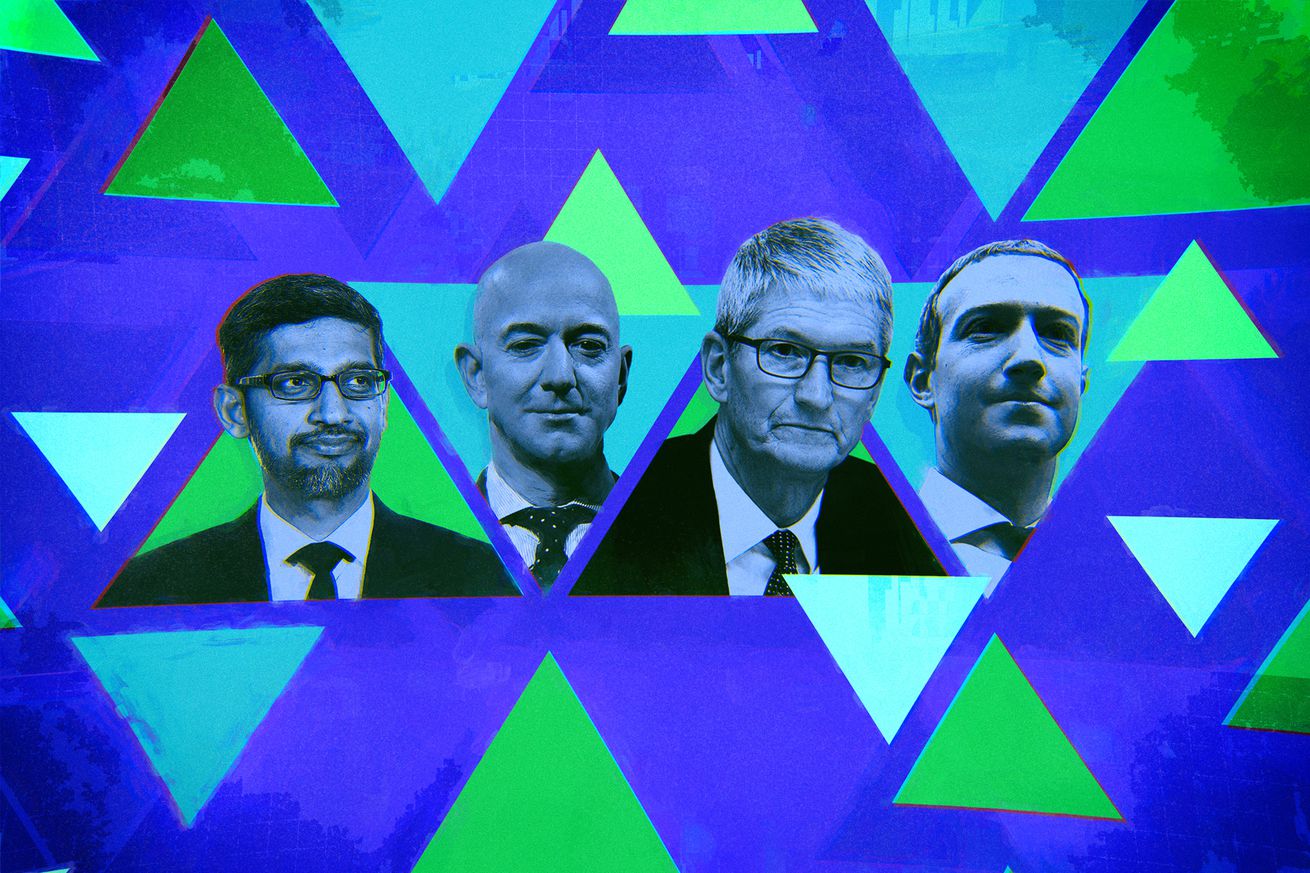
 Illustration by Alex Castro / The Verge
From a pure entertainment perspective, I am genuinely sorry that the House’s antitrust hearing targeting the big four tech companies — Amazon, Apple, Facebook and Google — took place Wednesday instead of next week. Because literally a day after a meeting attempting to determine if Big Tech was too big, three of the four companies in the hearing got bigger. (Google’s parent company, Alphabet, had a decline in revenue of about 2 percent, mostly due to a decline in search ads — but this was still better than analysts predicted.)
The hearing was about how tech companies have consolidated their power. The coronavirus seems to be making that consolidation even easier. No wonder, when it became clear the antitrust hearing would be delayed, that the rescheduled hearing took place before earnings. None of these companies wanted their earnings numbers read aloud to them before questioning began. Those four companies combined took in $28.6 billion in profits in just one quarter.
Look, I’m not going to pretend it’s a surprise that during the first full coronavirus quarter, the tech behemoths did well. Most of us are staying home if we can! There’s a virus out there! Of course we’re looking for other ways to amuse ourselves — just check out those YouTube numbers. Despite a massive decline in advertising spending, YouTube revenue rose to $3.8 billion this year from $3.6 billion last year. Facebook’s business is largely ad-based as well — and its revenue also rose to $18.7 billion as its users doomscrolled their way through the pandemic, even though several companies publicly boycotted the platform.
Meanwhile, Amazon doubled its profit as more people ordered delivery to their homes: $5.2 billion this quarter, from $2.6 billion last year. And Apple, which had many of its stores closed for chunks of the quarter, still made $11.25 billion in profit as people bought devices to entertain themselves.
The rest of the economy isn’t doing too hot, though. The overall US economy contracted 32 percent last quarter from 2019. It’s a grim record, the worst-ever quarter in the 70 years we’ve kept track. Compared to the overall contraction in the economy, you can see why Alphabet investors thought a 2 percent decline in revenue was a win.
It’s worth remembering that tech companies — including ones that didn’t report earnings today, such as Microsoft, which is also having a profitable pandemic — responded quickly to COVID-19 by closing offices and stores. Google said Monday it doesn’t expect its workers back in the office until July 2021 at the earliest; Facebook said in May it expected to have a larger remote staff as a permanent feature. Most Apple employees will work from home until 2021, CEO Tim Cook told Bloomberg.
If other workplaces follow this trend, Big Tech is composed of precisely the companies that stand to benefit from remote work. Amazon, for instance, was buoyed by the video chat client Zoom, since its cloud services division AWS hosts a chunk of Zoom. AWS even earned a shout-out in the Zoom earnings call! Because of the rapid uptick in Zoom use during the pandemic, the company couldn’t scale its own data centers quickly enough. Zoom CEO Eric Yuan thanked AWS in his prepared remarks for “provisioning the majority of the new servers we needed, sometimes adding several thousands a day for several days in a row.”
Back in March, my friend, colleague, and drinking buddy Casey Newton noticed that the pandemic had provided these companies with a wave of good news: they reacted quickly and decisively. “In a dramatic change from only weeks before, news about Big Tech has been a bright spot at a time of great fear — and, increasingly, of grief,” Casey wrote. “Increasingly, journalists are asking whether the backlash against technology companies that has defined coverage of them for the past three and a half years might have come to an end.”
The antitrust hearing suggests that the answer to that is no. Americans are simultaneously more reliant than ever on Big Tech — and less trusting of it. The newly-released emails from Mark Zuckerberg, for instance, show Facebook trying to kneecap its competitors any way it can. Another batch of hearing-related emails, from Jeff Bezos this time, suggest Amazon bought Ring for “market position.”
As more people become more dependent on the web for work, school, and social contact, it seems likely that scrutiny over the tech giants’ anti-competitive practices will increase. But not, as this quarter shows, before these companies make a hefty chunk of change.
from The Verge - Teches https://ift.tt/33auRlG
via IFTTT
Comments
Post a Comment