By working with home entrepreneurs, Jakarta-based DishServe is creating an even more asset-light version of cloud kitchens
Cloud kitchens are already meant to reduce the burden of infrastructure on food and beverage brands by providing them with centralized facilities to prepare meals for delivery. This means the responsibility falls on cloud kitchen operators to make sure they have enough locations to meet demand from F&B clients, while ensuring fast deliveries to end customers.
Indonesian network DishServe has figured out a way to make running cloud kitchen networks even more asset-light. Launched by budget hotel startup RedDoorz’s former chief operating officer, DishServe partners with home kitchens instead of renting or buying its own facilities. It currently works with almost 100 home kitchens in Jakarta, and focuses on small- to medium-sized F&B brands, serving as their last-mile delivery network. Launched in fall 2020, DishServe has raised an undisclosed amount of pre-seed funding from Insignia Ventures Partners.
DishServe was founded in September 2020 by Rishabh Singhi. After leaving RedDoorz at the end of 2019, Singhi moved to New York, with plans to launch a new hospitality startup that could quickly convert any commercial space into members’ clubs like Soho House. The nascent company had already created sample pre-fabricated rooms and was about to start leasing property when the COVID-19 lockdown hit New York City in March 2020. Singhi said he went on a “soul searching spree” for a couple of months, deciding what to do and if he should return to Southeast Asia.
He realized that since many restaurants had to switch to online orders and delivery to survive the pandemic, this could potentially be an equalizer for small F&B brands that compete with larger players, like McDonald’s. But lockdowns meant that a lot of people had to pick from a limited range of restaurants close to where they lived. At the same time, Singhi saw that there were a lot of people who wanted to make more money, but couldn’t work outside of their homes, like stay-at-home moms.
DishServe was created to connect all three sides: F&B brands that want to expand without spending a lot of money, home entrepreneurs and diners hungry for more food options. Its other founders include Stefanie Irma, an early RedDoorz employee who served as its country head for the Philippines; serial entrepreneur Vinav Bhanawat; and Fathhi Mohamed, who also co-founded Sri Lankan on-demand taxi service PickMe.
The company works with F&B brands that typically have between just one to 15 retail locations, and want to increase their deliveries without opening new outlets. DishServe’s clients also include cloud kitchen companies who use its home kitchen network for last-mile distribution to expand their delivery coverage and catering services.
“The brands don’t to have to incur any upfront costs, and it’s a cheaper way to distribute as well because they don’t have to pay for electricity, plumbing and other things like that,” said Singhi. “And for agents, it gives them a chance to earn money from their homes.”
How it works
Before adding a home kitchen to its network, DishServe screens applicants by asking them to send in a series of photos, then doing an in-person check. If a kitchen is accepted, DishServe upgrades it so it has the same equipment and functionality as the other home kitchens in its network. The company covers the cost of the conversion process, which usually takes about three hours and costs $500 USD, and maintains ownership of the equipment, taking it back if a kitchen decided to stop working with DishServe. Singhi said DishServe is usually able to recover the cost of a conversion four months after a kitchen begins operating.
Home kitchens start out by serving DishServe’s own white-label brand as a trial run before it opens to other brands. Each can serve up to three additional brands at a time.
One important thing to note is that DishServe’s home kitchens, which are usually run by one person, don’t actually cook any food. Ingredients are provided by F&B brands, and home kitchen operators follow a standard set of procedures to heat, assemble and package meals for pick-up and delivery.
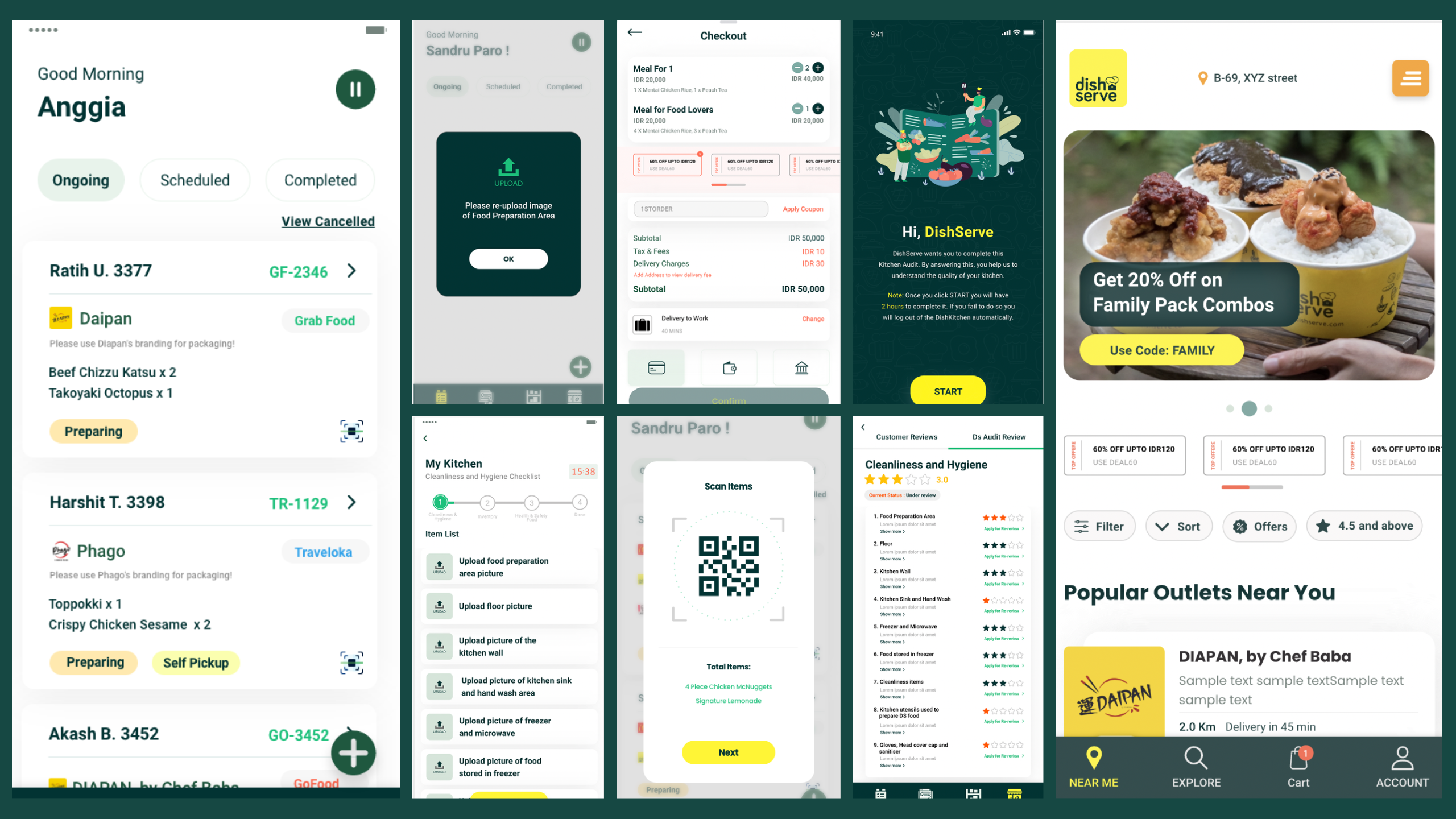
Screenshots of DishServe’s apps for home kitchen operators and customers
DishServe makes sure standard operating procedures and hygiene standards are being maintained through frequent online audits. Agents, or kitchen operators, regularly submit photos and videos of kitchens based on a checklist (i.e. food preparation area, floors, walls, hand-washing area and the inside of their freezers). Singhi said about 90% of its agents are women between the ages of 30 to 55, with an average household income of $1,000. By working with DishServe, they typically make an additional $600 a month once their kitchen is operating at full capacity with four brands. DishServe monetizes through a revenue-sharing model, charging F&B brands and splitting that with its agents.
After joining DishServe, F&B brands pick what home kitchens they want to work with, and then distribute ingredients to kitchens, using DishServe’s real-time dashboard to monitor stock. Some ingredients have a shelf life of up to six months, while perishables, like produce, dairy and eggs, are delivered daily. DishServe’s “starter pack” for onboarding new brands lets them pick pick five kitchens, but Singhi said most brands usually begin with between 10 to 20 kitchens so they can deliver to more spots in Jakarta and save money by preparing meals in bulk.
DishServe plans to focus on growing its network in Jakarta until at least the end of this year, before expanding into other cities. “One thing we are trying to change about the F&B industry is that instead of highly-concentrated, centralized food business, like what exists today, we are decentralizing it by enabling micro-entrepreneurs to act as a distribution network,” Singhi said.
from TechCrunch https://ift.tt/3i3xGfI
via Technology
Comments
Post a Comment