
Twitter’s verification chaos is now a security problem

Cybercriminals are already capitalizing on Twitter’s ongoing verification chaos by sending phishing emails designed to steal the passwords of unwitting users.

The phishing email campaign, seen by TechCrunch, attempts to lure Twitter users into posting their username and password on an attacker’s website disguised as a Twitter help form.

The email is sent from a Gmail account, links to a Google Doc with another link to a Google Site, which lets users host web content. This is likely to create several layers of obfuscation to make it more difficult for Google to detect abuse using its automatic scanning tools. But the page itself contains an embedded frame from another site, hosted on a Russian web host Beget, which asks for the user’s Twitter handle, password and phone number — enough to compromise accounts that don’t use stronger two-factor authentication.
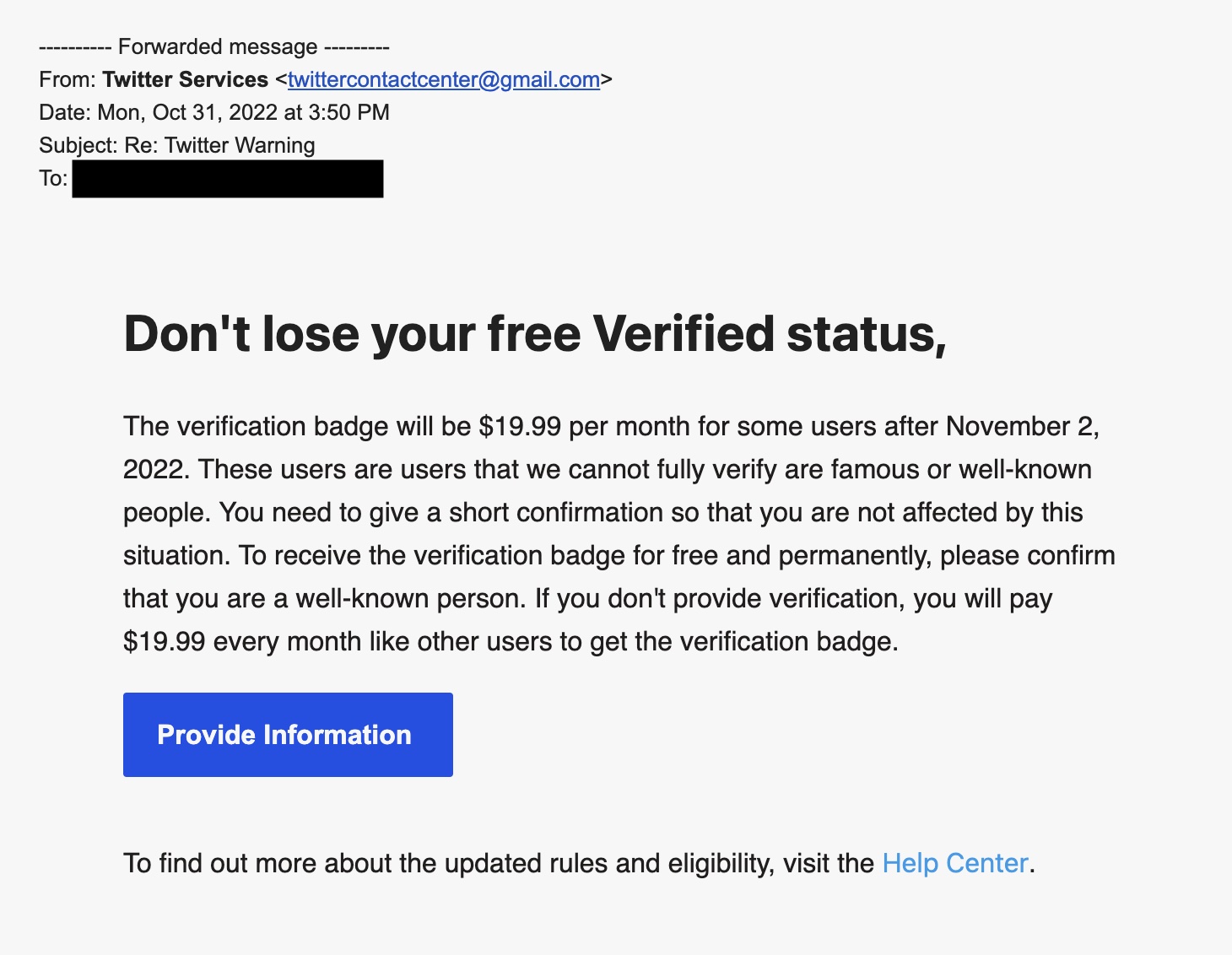
A screenshot of the phishing email designed to steal Twitter users’ credentials. Image Credits: TechCrunch.

The campaign appears crude in nature, likely because it was quickly put together to take advantage of the recent news that Twitter will soon charge users monthly for premium features, including verification, as well as the reported possibility of taking away verified badges of Twitter users who don’t pay.

As of the time of writing, Twitter has yet to make a public decision about the future of its verification program, which launched in 2009 to confirm the authenticity of certain Twitter accounts, such as public figures, celebrities and governments. But it clearly hasn’t stopped cybercriminals — even on the lower-skilled end — from taking advantage of the lack of clear information from Twitter since it went private this week following the close of Elon Musk’s $44 billion takeover.

TechCrunch has alerted Google and Beget to the phishing pages, but did not immediately hear back. A spokesperson for Twitter did not immediately respond to a request for comment.

Twitter’s verification chaos is now a security problem by Zack Whittaker originally published on TechCrunch


from TechCrunch https://ift.tt/kqKadX7
via Technology

Comments

Popular posts from this blog

Instagram accidentally reinstated Pornhub’s banned account

After years of on-and-off temporary suspensions, Instagram permanently banned Pornhub’s account in September. Then, for a short period of time this weekend, the account was reinstated. By Tuesday, it was permanently banned again. “This was done in error,” an Instagram spokesperson told TechCrunch. “As we’ve said previously, we permanently disabled this Instagram account for repeatedly violating our policies.” Instagram’s content guidelines prohibit  nudity and sexual solicitation . A Pornhub spokesperson told TechCrunch, though, that they believe the adult streaming platform’s account did not violate any guidelines. Instagram has not commented on the exact reasoning for the ban, or which policies the account violated. It’s worrying from a moderation perspective if a permanently banned Instagram account can accidentally get switched back on. Pornhub told TechCrunch that its account even received a notice from Instagram, stating that its ban had been a mistake (that message itse...

Watch Aidy Bryant *completely* lose it as 'SNL' roasts political pundits

On Saturday Night Live , there are breaks and then there's whatever happened here. The Season 45 premiere featured a sketch that was meant to expose the empty noisemaking of political punditry on TV. But part of the joke involved a series of quick costume changes, and some weirdness during one of those switches led to a complete and total breakdown. Aidy Bryant, the segment's host, couldn't take it. She manages to keep it together until what appears to be an accidental wide shot exposes some of the magic as we see a woman who's probably a member of the SNL wardrobe crew fiddling with Aidy's costume. Read more... More about Saturday Night Live , Aidy Bryant , Entertainment , and Movies Tv Shows from Mashable https://ift.tt/2okrAOq via IFTTT

MVP versus EVP: Is it time to introduce ethics into the agile startup model?

Anand Rao Contributor Share on Twitter Anand Rao is global head of AI at PwC . The rocket ship trajectory of a startup is well known: Get an idea, build a team and slap together a minimum viable product (MVP) that you can get in front of users. However, today’s startups need to reconsider the MVP model as artificial intelligence (AI) and machine learning (ML) become ubiquitous in tech products and the market grows increasingly conscious of the ethical implications of AI augmenting or replacing humans in the decision-making process. An MVP allows you to collect critical feedback from your target market that then informs the minimum development required to launch a product — creating a powerful feedback loop that drives today’s customer-led business. This lean, agile model has been extremely successful over the past two decades — launching thousands of successful startups, some of which have grown into billion-dollar companies. However, building high-performing product...